1
Format
Our AI agent clarifies it with you: qualitative or quantitative.
Ad hoc primary research for market research agencies and insights teams
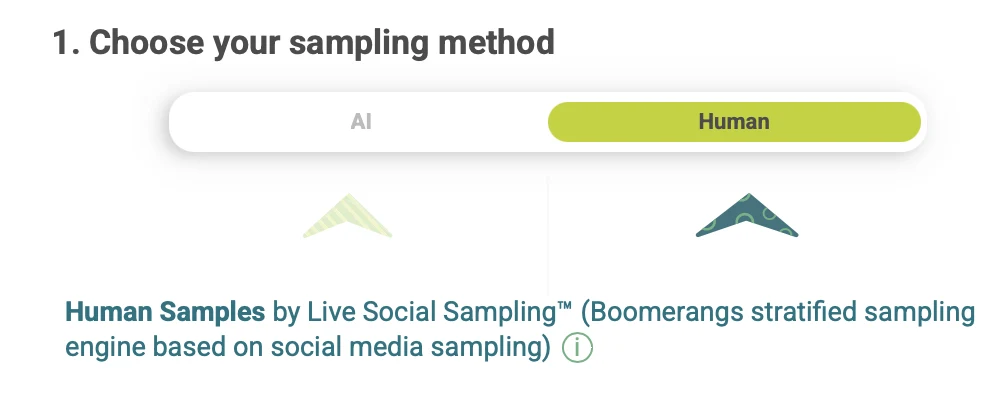
Because they sit in no panel and don't answer for points. We ask them where they already are: on social media. One-off surveys, trackers, your own questionnaires in the field. Plus simulations for indicative pre-studies and more.
 uses Boomerang as part of the sample for the SRF Trend Surveys





Why does this matter?
Not a case against panels — a case for the gap they leave.
36 % → 6 %
Response rate in telephone surveys, 1997 versus 2018.
Pew Research Center (US)
<1 % → 34 %
<1 % of panel members completed 34 % of all questionnaires (ten largest US panels).
comScore, 2006
39 vs. 0.2
Surveys a month taken by experienced panellists. People sampled at random take 0.2 in six months.
Liljeberg/Krambeer, planung & analyse 1/2012 (DE)
1.5 %→3.1 %→3.9 %
Average absolute error of election forecasts: 1970–1990, US 2016, US 2020.
FiveThirtyEight & AAPOR
What is the product?
1
Our AI agent clarifies it with you: qualitative or quantitative.
2
The agent's draft from strategy and topic, a template, a blank start, or a link to your own, from Qualtrics for example.
3
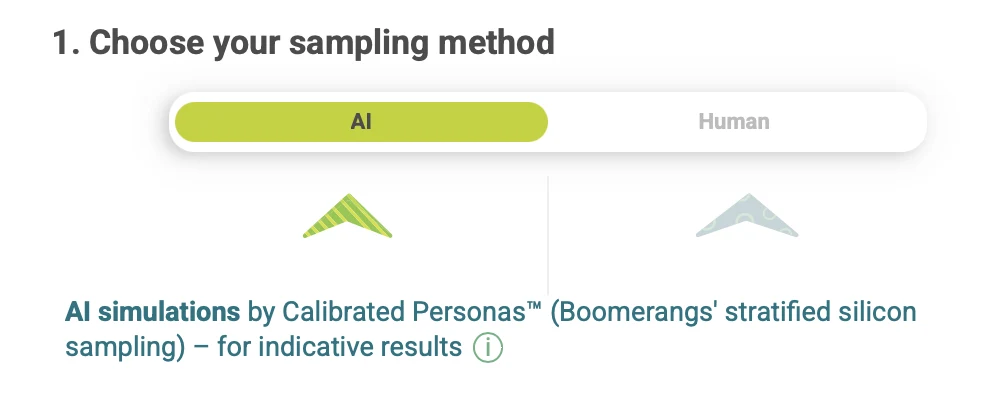
Simulated answers for an indicative result, from close to four years of research into synthetic opinions.
4
Nothing for you to do. Ad hoc recruitment across all social media channels, feasibility checked upfront, every quota secured.
5
Weighted in the dashboard, live while the survey is in field, with drill-downs and a PDF report.
Representative ad hoc survey, freshly recruited, with quotas on age, gender and region. Sample size of your choice.
Your questionnaire in Qualtrics, SurveyMonkey, Nebu and others. We supply the sample, long instruments included.
Interview participants: screened, incentivised, scheduled.
The same questionnaire, answered in minutes. Meant for pre-studies and small budgets. Confidence Guard™ gives the plausibility; where it does not hold, one click to real people.
Declared as simulation, reported separately, never part of a human sample.
The same instrument every quarter, so movement is comparable across waves.
Twelve brand metrics, including awareness, image, recommendation (NPS), loyalty and preference, plus the Brand Equity Score.
“We use Boomerang Ideas to gather fast market & consumer insights for our clients and ourselves. It helps us make informed decisions and suggest concepts based on consumer insights.”
 Patrick Glauser · Managing Partner, TMI AG
“The insights we gained from Boomerang Metrics were invaluable in refining and improving our marketing strategy.”
 Carsten Richter · Digital Manager, Lindt & Sprüngli
“Running six targeted Boomerang surveys across multiple markets proved to be fast, intuitive, and engaging. The Boomerang platform delivered professional insights that enabled us to validate our personas and refine our targeting strategy with confidence.”
 Philipp Köstner · Lead Online Marketing, BERNINA International
How do we reach participants?
That is why people answer here whom classical fieldwork no longer reaches. Primary research, not scraped data.
Does the algorithm skew the sample?
Recruit through ads and you get the people who click on ads — a fair objection. Four measures against it:
Each subgroup is addressed separately through micro-targeting, so the algorithm cannot fall back on the easiest users to reach.
For CH, DE and AT: age, gender and region quoted together, so the cheapest group cannot fill the quota of the most expensive. Standard quotas in other markets.
Weighted to the national statistical office's data, not to a panel's structure.
Multi-stage, including attention checks, speeder and duplicate detection, reCAPTCHA and IP checks.
Why should you trust our method?
Two human-sampling studies with Universität Zürich: pre-study 2021, validation study 2023/24, against an established online panel.
81 % vs. 37 %
Passed attention checks.
UZH study II (USA): n = 1,000 Boomerang, n = 1,000 Qualtrics
42 % vs. 20 %
Stay in the study instead of dropping out.
UZH study II (USA): n = 1,000 Boomerang, n = 1,000 Qualtrics
2.91 vs. 3.04
Trust in science (1–4), lower — read as less social-desirability bias.
UZH study II (USA): n = 1,000 per group, p = .001
3.76 vs. 3.96
Survey experience, lower — read as less practised respondents.
UZH study II (USA): n = 1,000 per group, p < .001
2 of 3
In two of three referendums closer to the result than established institutes.
UZH pre-study: 13 surveys with n = 416 to 976, three of them referendums
0.25 vs. 3.6
Deviation in points, Nevada 2024. Internal analysis, single case.
100 % human sampling, US 2024
1,000 in 6 days
Field time in the pre-study. The institute needed 10 days for the same sample.
UZH pre-study: n = 1,000
These figures apply to real people, recruited ad hoc on TikTok, Snapchat, Facebook and more. The evidence for the simulation follows further down.
What are synthetic pre-studies worth?
What matters is what the simulation is built on, and what happens when it is not enough.
Trained on decades of gfs.bern survey data in Switzerland and on data from further international research partners — not on web text.
Measured on five studies the model never saw: 82.6 % overlap* between simulated and real answer distributions. Frontier models without this training stay below 52 %.
Every simulation is scored by Confidence Guard™, a second, independent judge model: plausibility, from 0 to 10.
The higher, the more robust.
The simulation holds. Work with the result.
Trust the ranking, not yet the individual percentage. Check with human sampling before a budget decision (directly in the tool).
The simulation is not enough — this question needs people to answer it. We say so next to the result, not in the small print.
Recruitment is ours: our own channels, new for every study. That is why «real people now» is a button, not a project — 3 to 7 days to the result.
Measure a simulation against panel data and you inherit the panel's gaps. Our reference: freshly recruited people.
The only platform that runs both engines itself and measures them against each other continuously.
* The 82.6 % comes from Swiss validation studies. Plausibility measures consistency and fit, never accuracy against a known result.
Confidence Guard™ recommends; the decision is made by hand. We are researching the automatic step with Basel and Johns Hopkins — research, not a feature.

Funded several times by Innosuisse since 2020. The current project, «Confidence-Driven Augmentation of Synthetic Survey Data», runs with Universität Basel and Johns Hopkins University.
Cost and contact
Germany from CHF 4 per completed response, Switzerland and Austria from 5. You commission us directly.
The price becomes binding with the free pre-test. If we cannot find your target group, you get your money back.
CHF 10–15 per complete
CHF 3,000–4,500 for n = 300 · excl. VAT
Above the base price, because the screening question narrows the target group.
Without a screener, general population CH: CHF 5–10 per complete. CHF 1,500–3,000 for n = 300.
from EUR 4 per complete
from EUR 1,200 for n = 300 · excl. VAT
Base price Germany, general population.
A screening question narrows the target group and raises the price; by how much depends on its incidence. The range is in the quote.
from USD 3 per complete
from USD 900 for n = 300 · excl. VAT
Base price USA, general population.
A screening question narrows the target group and raises the price; by how much depends on its incidence. The range is in the quote.
only the credits used
CHF 1,950 · 4,950 · 11,950
same price, Pro included
1 credit = CHF 1. The quote is what counts.
Reply within 1–3 working days with feasibility, a price range and a pre-test proposal.
24 countries: Argentina, Australia, Austria, Brazil, Canada, Czech Republic, France, Germany, India, Italy, Kenya, Mexico, Nigeria, Poland, Portugal, Saudi Arabia, South Africa, South Korea, Spain, Sweden, Switzerland, Thailand, the UK and the USA. Switzerland, Germany and Austria can also be cross-quoted on request, at a surcharge.
DE from CHF 4 per completed response, CH/AT from 5. General population CH typically 5–10.
Field time is 3–7 days, depending on sample and questionnaire. You see the first answers live.
For pre-studies: indicative results in minutes, scored by Confidence Guard. Switching to real people is one click.
Among others attention checks, speeder and duplicate detection, reCAPTCHA, IP checks. Incentives paid fairly per minute, after the quality check.
The report and raw data are yours. We collect minimal data, anonymise fully and work in line with GDPR and the revised Swiss FADP.



⠿ verschieben
Als anonym